







From Customer Feedback to Innovation: Connecting European Needs with Chinese Engineering


-
Hymson Laser
-
News
-
Corporate News
Innovation doesn't always begin in a laboratory.
Sometimes, it begins with a conversation with a customer.
A customer explains a production challenge. An engineer asks a few more questions. Someone visits the production line. A new requirement is identified.
Then comes the difficult part:
How quickly can that requirement become a real product improvement?
For Hymson, this question is becoming increasingly important as we expand our presence in Europe.
The Importance of Being Close to the Customer
One of the key challenges of international expansion is creating an effective connection between the customer and the engineering team.
A European customer may have a very specific production requirement.
It could involve:
· A smaller production batch;
· Greater machine flexibility;
· Higher levels of automation;
· A different workflow;
· A specific usability requirement;
· Or simply a small design detail that makes a significant difference on the production floor.
These details can be difficult to communicate through emails, specifications, and video conferences alone.
Sometimes, engineers need to stand next to the machine and see the problem for themselves.
That is why direct interaction between Hymson's European and Chinese teams is so valuable.
From Europe to China — and Back Again
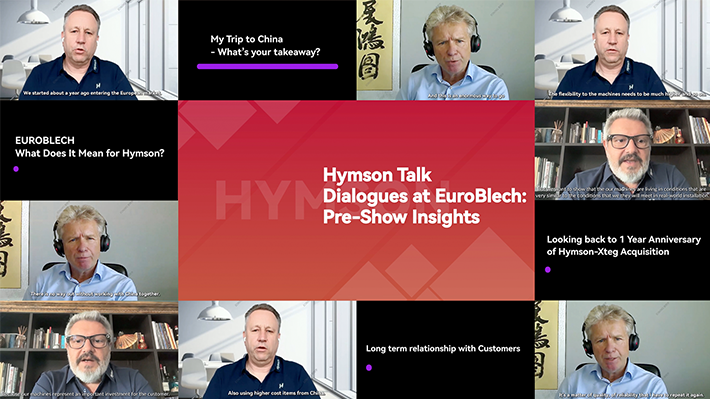
When our European team visits Hymson's engineering and manufacturing facilities in China, the objective is not simply to review existing machines.
It is an opportunity to bring European customer requirements directly to the engineers who design and build the equipment.
The process can be remarkably direct:
Customer Requirement
↓
European Team
↓
Chinese Engineering Team
↓
Design Modification
↓
Prototype & Testing
↓
Customer Validation
This feedback loop allows ideas to move quickly from the market to engineering and back to the market.
Why Face-to-Face Collaboration Matters
In today's connected world, it is easy to assume that everything can be done remotely.
But physical products are different.
When you are standing next to a machine, you can see how an operator interacts with it.
You can see where a component is located.
You can understand the workflow.
You can discuss a design change with an engineer and immediately walk over to the machine to see what is possible.
These interactions can turn an abstract customer requirement into a concrete engineering solution.
And there is another important factor: responsiveness.
Our Chinese engineering teams have shown a strong willingness to listen to feedback from the European organization and make changes based on market requirements.
That openness creates an important advantage.
Not because every idea can or should be implemented, but because there is a willingness to listen, evaluate, test, and adapt.
The Next Step: From Localization to Co-Innovation
There is an important difference between localization and innovation.
Localization asks:
“How do we adapt our existing product to this market?”
Co-innovation asks a bigger question:
“What should we develop together with this market?”
This is where we want to go.
Europe should not simply be a market where Hymson sells products developed elsewhere.
European customers and engineering teams can become an important source of ideas for the next generation of Hymson products.
At the same time, our Chinese engineering organization can provide the resources and development capabilities needed to turn those ideas into products.
That creates a two-way relationship:
Europe brings customer insight.
China brings engineering scale and development capability.
Together, they create new solutions.
Building a Faster Innovation Loop
As Hymson continues to develop in Europe, one of our priorities is to make this feedback loop even stronger.
The ultimate objective is simple:
Listen faster.
Understand better.
Develop faster.
Validate earlier.
Deliver greater customer value.
For us, internationalization is therefore not simply about selling products in another country.
It is about creating a global organization where customer insight, engineering capability, and innovation can move across borders.
And sometimes, the best innovation starts with something very simple:
Listening to the customer.


